669
Posts
535
Followers
Pasadena Media Foundation is dedicated to saving local news. Our publications feature provocative reporting about the Greater Pasadena and Greater Southern California areas.
‘Student debt crisis is one of the civil rights issues of our time.’ Geoffrey Baum
By Sheryl Turner,
20 hours ago
“I’ve got a long record in this,” Baum said, ticking through the expenses that follow a PCC student far beyond tuition. “The most expensive things that students are facing today are the cost of transportation. The cost of housing. The cost of healthcare.” Those, he acknowledged, sit largely outside a community college’s control. But one line item, he said, doesn’t have to.
The textbook fight
“One of the things that I’m very concerned about is the cost of textbooks,” said Baum, a former PCC student himself. “The cost of textbooks far outstrips the cost of tuition.” He recalled during his own student days the sticker shock of individual titles running “over $200 for a textbook.”
His answer for PCC students, developed over years of work with faculty, is what’s known as open educational resources—course materials built and hosted on a shared platform instead of sold by a publisher.
“What we’ve done, and I’ve worked closely with faculty on this, is deploy the use of what we call open educational resources, where textbooks are created on a Creative Commons platform, and are free to the students, but they’re also free for a faculty member to modify and create,” he explained.
Faculty still control their own syllabi and reading lists, he was careful to note. The goal isn’t to override their judgment but to give them a genuine free alternative to commercial publishers.
“If we make sure that in a biology, chemistry, Spanish, or math class that there’s a free textbook that’s every bit as good as the one that Pearson or McGraw Hill is going to charge you $200-$300 for,” he said, “we hope the faculty will make both choices available to their students or assign the free one.”
That effort scaled up into state policy. Baum said he pushed to establish what the system calls zero-textbook-cost degree pathways—a designation that lets students search the course catalog and build an entire degree without buying a single book.
“A student now can create a pathway and get a degree without paying a single dollar for textbooks,” he said. The idea traces back, he said, to his time as president of the state community college board and later at a family foundation, where the concept became a statewide pilot before Gov. Gavin Newsom put roughly $115 million behind it, funding faculty time to build the free curricula and deploying the model across California’s community colleges.
Baum pointed to a second, less obvious source of savings: making sure students take only the classes that actually count toward a degree. Getting transfer pathways aligned with what the Cal States and UCs will accept, he said, keeps students from paying for—and sitting through—courses that go nowhere.
“That’s the other way,” he said, “and it saves you both the tuition money and the textbook money and just gives you the freedom to do that.”
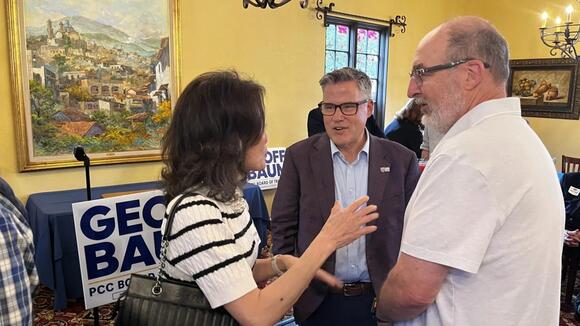
Debt as a ‘civil rights issue’
Baum framed the affordability push in far larger terms than a single campus budget line.
“I consider the student debt crisis one of the civil rights issues of our time,” he said. “We’ve made these promises to people saying at all costs, get that college degree” — degrees, he argued, that have gotten far more expensive as wages have not kept pace.
“I know too many students who are drowning in debt they can’t get rid of — they can’t afford a house, or they can’t afford rent,” he said. “We’ve really victimized this generation, and we need to do something about it.”
Community college, in his telling, is the counter-model.
“You will get as good an education at PCC as a freshman as you would at USC,” said Baum, who spent much of his career working in higher education at USC. Most PCC students, he noted, qualify for a tuition waiver, and he pointed to expanded access to Pell and Cal Grants as further softening the blow of living expenses. He also cited the PCC Foundation, on whose board he served for five years, as a source of emergency student aid — including help for students, faculty and staff displaced by the recent wildfires.
Still, Baum said affordability is only half the job. “We have an obligation on the community college level,” he said. “We have to make sure students get what they need and earn whatever certificate or degree and graduate or get transferred.” He pointed to a recent EdSource analysis showing statewide transfer numbers slipping even as PCCs have continued to climb—evidence, he argued, that the college’s approach is working and needs to be protected.
Training for jobs that are ‘waiting’
Baum tied the affordability argument directly to workforce programs he says are already paying off for students. He described meeting a young man near Flintridge who had a four-year degree and no job offers—until he enrolled in PCC’s short-term building inspector program.
“He’s enrolled in that now, and he’s going to have a job in less than a year because those jobs are waiting,” Baum said.
He also raised the issue with the head of the Pasadena firefighters union about the pipeline of skilled trades workers needed to keep emergency equipment running — a shortage he said became acute during the Palisades fire.
“One of the things that PCC could do is make sure there’s a strong pipeline of trained mechanics and experts who can do the work to keep and maintain the equipment,” Baum said. “Those are things you can’t outsource to AI.”
Weathering the budget deficit
Asked what would help PCC through a looming budget deficit, Baum pointed back to his prior board tenure, when the college absorbed a sudden midyear cut without disrupting classes or staff.
“We managed our resources very effectively,” he said. “We kept a full schedule of classes, and we didn’t lay off a single individual.” He credited a combination of healthy reserves, disciplined planning for long-term obligations like retiree health benefits and pensions, and philanthropic support — including a $30 million gift from MacKenzie Scott, part of what Baum said has grown into nearly $100 million raised by the PCC Foundation over the years.
Physical investment matters too, he said, crediting district voters for funding facilities able to support the college’s growing certificate programs.
Why run again?
Baum, who has run for the PCC board three times before, said the choice to jump back in this cycle followed the pandemic, the unrest after George Floyd’s murder, and, most directly, the recent wildfires.
“PCC was the place that became a center for relief,” he said, noting the campus offered itself as a FEMA site and that the college lost hundreds of students, faculty and staff to displacement. “So to me, it was more important than ever to serve again,” he said, once a group of longtime civic figures — among them former state chancellor Jack Scott — encouraged him to run again.
He also framed the moment in historical terms, pointing to the civic building spree that followed the 1918 flu pandemic and World War I, when Pasadena built the Rose Bowl, the Huntington Library and PCC itself, all within a few years of one another.
“We have both the opportunity and the responsibility to set us on a new trajectory,” he said, “that’s going to be both more inclusive, but also ambitious and forward-looking.”
Even with an opponent on the ballot this cycle — something he said he welcomes after two contested races and one unopposed run — Baum argued that competitive elections force a conversation voters otherwise don’t get.
“When you don’t have an opponent, it deprives you of the opportunity to reach out and say, hey, let’s have a conversation. Let’s talk about the community college,” he said. “Did you know we offer over 100 certificate programs? Did you know we have a simple transfer pathway?”
A personal note
Asked what voters might not know about him from his campaign materials, Baum turned to his family.
“My dad, as a refugee, fled certain death in a war and came to this country,” he said. “Thankfully, his grandmother had a restaurant in Brooklyn, and they were able to get a visa to come here. He’s a naturalized citizen. He’s a non-native English speaker.”
His mother’s path was harder still, he said: “Her parents were divorced when she was four,” and she later dropped out of high school before marrying and eventually settling with Baum’s father in Seal Beach, where both parents became active in local politics. Of his own four brothers, Baum said, “I’m the only one that finished college.”
“I try to be very focused — it’s not about me, it’s about helping the students, helping those who didn’t have those opportunities,” he said. “If I can open the door or lift one person or one student” — he paused — “I think that will make a difference.”
Comments
YOU MAY ALSO LIKE
CJ Coombs
CJ Coombs
Bizarre disappearance of a Sacramento, California, mother and her two boys in 1978
Richard "Ricky" Houghland and his brother, Thomas J. "Tommy" Houghland, have been missing from Sacramento, California, since July 11, 1978. Richard's photo above is shown age-progressed to 52 years, though he would now be 56 if alive. Thomas's photo below is age-progressed to 49 years, but he would now be 53 if alive.
Edmond Thorne
CJ Coombs
CJ Coombs
The 1994 unsolved disappearance of infant Kelsi Krum and her mother in Arcadia, Florida
Kelsi Jordan Krum has been missing from Arcadia, Florida (DeSoto County), since August 11, 1994, according to the National Center for Missing and Exploited Children (NCMEC). Her mother, Kelli Jo Krum (pictured below), also disappeared. Kelsi would now be 32 years old, and her mother would be 53.
Pasadena Media Foundation is dedicated to saving local news. Our publications feature provocative reporting about the Greater Pasadena and Greater Southern California areas.
669
Posts
535
Followers