729
Posts
552
Followers
Pasadena Media Foundation is dedicated to saving local news. Our publications feature provocative reporting about the Greater Pasadena and Greater Southern California areas.
For the unhoused, there’s a complicated bond between people and their pets
By Barbara Bishop,
12 hours ago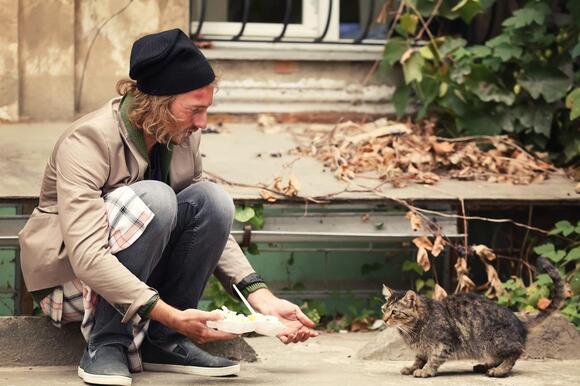
For people living on the streets of Los Angeles and Pasadena, a dog curled up beside a sleeping bag can be much more than a pet. It can be family, protection, companionship and, for someone who may have lost nearly everything else, a reason to keep going.
But the sight of an unhoused person with an animal often raises a difficult question: Is it fair to keep a pet when you don’t have a home yourself?
Research suggests the answer is far more complicated than it might appear.
A groundbreaking study by USC researchers led by Daniel Henwood examined pet ownership among unsheltered adults in Los Angeles County and found that an estimated 9 to 12 percent had pets across three years (2017-2019). The findings were stark: among pet owners surveyed in 2017, 48 percent reported having been turned away from shelters because of pet policies. This barrier keeps many people from accessing emergency housing. The research, published in the Journal of Social Distress and Homelessness, underscores how pet policies can create impossible choices for unhoused people.
For many, giving up the animal isn’t an acceptable alternative.
Academic research on people experiencing homelessness documents an unusually strong human-animal bond. Multiple studies, including research from the University of Denver’s Institute for Human-Animal Connection and work by scholars like Leslie Irvine (author of My Dog Always Eats First), show that pets provide essential companionship, emotional support, security, routine and a sense of responsibility. Some homeless pet owners report feeding their animals before feeding themselves or prioritizing their pets’ needs ahead of their own—a testament to the depth of their commitment.
There are legitimate concerns. Living outdoors exposes animals to heat, cold and other dangers, while the cost of food and veterinary treatment can be difficult for someone with little or no income. Access to routine vaccinations, medications and emergency veterinary treatment may also be limited.
Yet homelessness by itself does not necessarily mean an animal is being neglected.
A Canadian veterinary study examining the health of dogs belonging to people experiencing homelessness found that the animals compared favorably with conventionally owned pets in most measures, including overall companionship and exercise. The research identified a major barrier: difficulty accessing routine and emergency veterinary care—driven by cost and access rather than owner neglect.
That distinction is important when concerns about animal abuse arise. Abuse and neglect should be investigated regardless of whether an owner is housed or homeless. But research—including studies cited by animal welfare organizations like the ASPCA—shows no evidence that simply being homeless makes someone an abusive pet owner. Instead, the barriers are structural: lack of money for veterinary care, limited access to pet-friendly emergency housing, and shelter policies that refuse to accommodate animals.
Locally, Pasadena Humane offers programs designed to help people keep their animals rather than surrender them when financial difficulties arise. Its services include owner assistance and a Pet Food Bank, including emergency assistance for people whose pets may otherwise go without food.
Perhaps one of the greatest challenges is that helping the animal and helping the person are often inseparable. Someone may decline temporary shelter, medical treatment or other assistance if accepting it means abandoning a beloved dog or cat.
The image of a homeless person sharing a blanket or meal with a dog can be uncomfortable to witness. But experts increasingly suggest that the better question may not be whether homeless people should be allowed to have pets.
Instead, the question may be: How can communities protect the animal’s welfare while preserving a relationship that may be one of the most important things its owner has left?
Sources & Further Reading
- Henwood, D., Dzubur, E., Rhoades, H., & St. Clair, S. (2020). \”Pet ownership in the unsheltered homeless population in Los Angeles.\” Journal of Social Distress and Homelessness, 30(2).
- ASPCA. (2024). \”People with Pets Experiencing Homelessness.\”
- Irvine, L. (2013). My Dog Always Eats First: Homeless People and Their Animals. Lynne Rienner Publishers.
- Feeding Pets of the Homeless.
- Pasadena Humane.
- University of Denver Institute for Human-Animal Connection.

About This Story
All our stories are free to read. Funded by our nonprofit, Pasadena Media Foundation, we don’t believe local news should be locked behind paywalls or cluttered with ads. We also share our news for free with other local (and not-so-local) media organizations across the country. We collaborate with local newsrooms and co-publish articles so our work is shared as widely as possible. Launched three years ago, we’ve earned 30 local and national journalism awards. We tell stories, hold authority accountable, and report only accurate fact-checked information. If you find our work valuable, please consider helping us reach even more readers in more places. Your tax-deductible donation in any amount makes a difference.


Comments
Is Your Senior Dog in Pain and You Don't Know It?
Leonberger Breed Guide: Facts, Health & Care | Australia's #1 Pet Store
Owners often overlook subtle behavioral shifts that indicate pain in senior dogs.
YOU MAY ALSO LIKE
CJ Coombs
Missing since 1973 from Creswell, Oregon: Deborah Lee Tomlinson just turned 16 when she disappeared
Deborah Lee "Debbie" Tomlinson has been missing from Creswell, Oregon (Lane County), since October 15, 1973, according to the National Center for Missing and Exploited Children (NCMEC). Her photo above (right) is an age-progressed likeness of how she might have looked at 58, though she would now be 68.
CJ Coombs
The Baby Jane Doe, who was abandoned in 1998 in Northeast Washington D.C. is still a mystery
Baby Jane Doe was found abandoned in Washington, D.C., on March 20, 1998. She would now be 28, according to the National Center for Missing and Exploited Children (NCMEC). As of today, seven missing children from Washington, D.C. are listed with the NCMEC, and the oldest case dates back to 1961. Notably, not all missing children are reported to the NCMEC, but they should be.
Dianna Carney
Three Gentle Giants Found Wandering Together: Now They Just Need Someone to Choose Them
Three Mastiff-mix dogs, Chance, Duncan and Isabel, are ready to trade their wandering days for permanent homes, according to the Scituate Animal Shelter of Massachusetts. The shelter recently introduced them with an invitation to adopters: “Meet Chance, Duncan + Isabel… three VERY big reasons to fall in love,” adding that each dog arrived after being found roaming together in Stoughton and is now looking for “a home of their own.”
CJ Coombs
Missing since 2023 from Redmond, Washington: Noah and Oliver Richard have had little media focus
Noah Henry Richard has been missing from Redmond, Washington, since December 14, 2023, according to the National Center for Missing and Exploited Children (NCMEC). Noah, pictured above, was two when he went missing, but he would now be five years old. His brother, Oliver Richard (pictured below), was only seven months old when he also went missing on the same date. Oliver would now be three.
Pasadena Media Foundation is dedicated to saving local news. Our publications feature provocative reporting about the Greater Pasadena and Greater Southern California areas.
729
Posts
552
Followers